
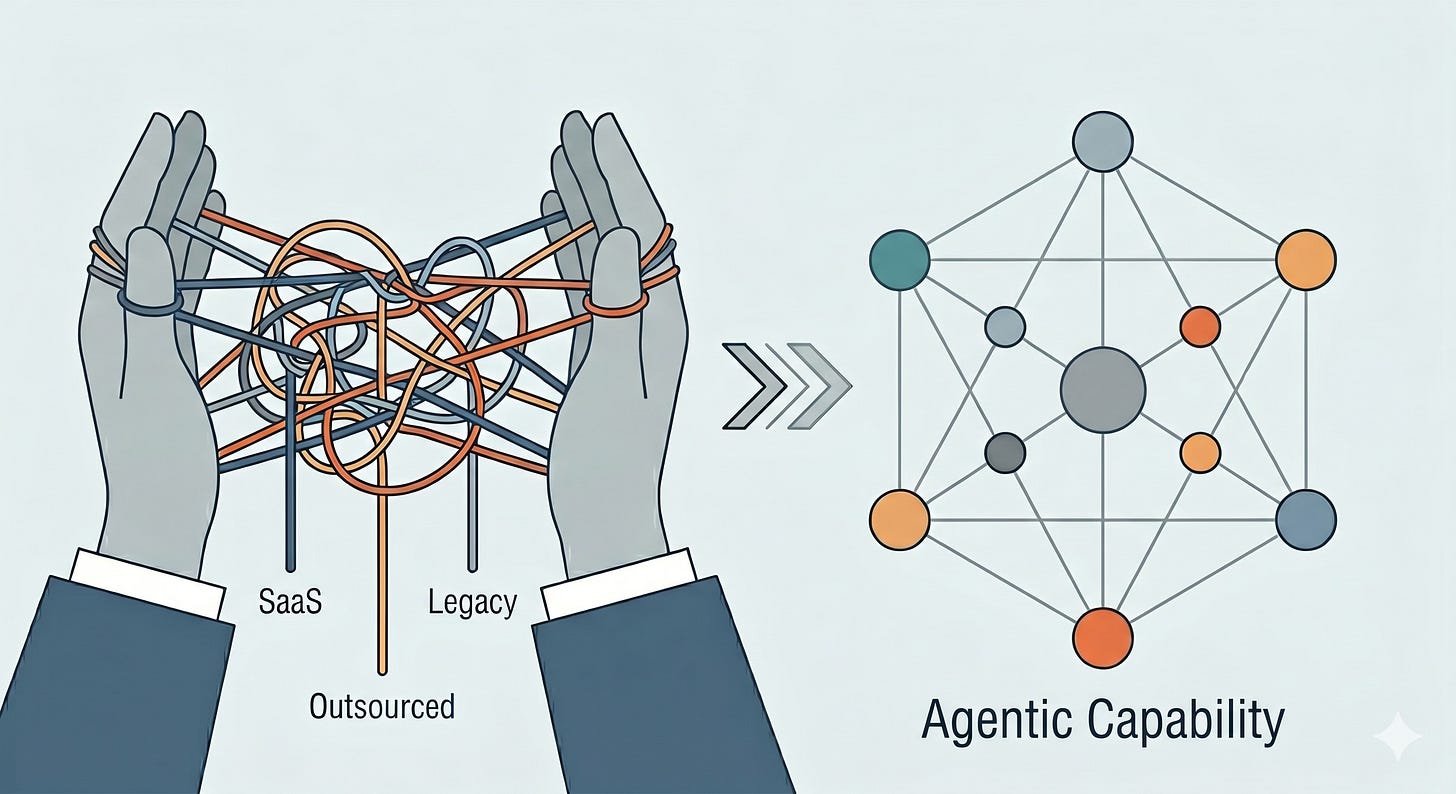
For the past couple of weeks, I have been interviewing senior function heads and operational leaders in a large hi-tech firm as part of an AI literacy programme. What struck me most was not their enthusiasm for AI, but the degree to which they already know what they would build. Those who own and understand their core value streams demonstrated the desire, experience, and knowledge to design and run their own custom-built agentic applications in preference to settling for good-enough process management or last-generation SaaS platforms.
This gives me optimism in the face of widespread uncertainty about enterprise AI ROI. Several commentators have explored this recently, and their diagnoses are useful; but they all point to a solution that requires operational leaders to be in the driving seat, not waiting on the sidelines for technology teams and consultants to hand them something.
From Lightbulbs to Learning Loops
Azeem Azhar last week tackled Why AI isn’t showing up on your bottom line, likening the current situation to the thirty-year gap between the dawn of industrial electrification and the moment when this general-purpose technology finally started to transform factory productivity. His three-phase breakdown maps well onto what we are seeing now:
- The lightbulb (stage 1): improved the workplace through illumination but did not change the operating logic
- The group drive (stage 2): used the existing factory layout and accelerated processes, but did not redesign the system
- The unit drive (stage 3): redesigned workflows and structures to take advantage of what electrification made possible
The critical difference between stages two and three was not the technology — it was who redesigned the floor plan and who owned the result. To become a stage-three firm requires not just faster workflows but a faster coordination architecture. Without it, AI-enabled productivity gains can paradoxically worsen system congestion rather than reduce it, and increase the “coordination tax” — that hidden overhead of meetings, approvals and status updates that agentic AI should be dissolving, not embedding deeper into a new layer of tooling.
Ethan Mollick recently made a complementary point: individual productivity gains from AI are not being captured as organisational improvement, and the reason is structural. He argues we need to do a better job of combining leadership, the lab, and the crowd inside firms:
The key is treating AI adoption as an organizational learning challenge, not merely a technical one. Successful companies are building feedback loops between Leadership, Lab, and Crowd that let them learn faster than their competitors… critically, they’re not outsourcing or ignoring this challenge.
The Sticky-Tape Problem
The dominant model of enterprise AI adoption right now is additive: take existing operating structures, layer AI tools on top, and hope for returns. PWC UK’s Chief AI Officer, quoted in an MIT Technology Review piece on organisational design, describes this as embedding AI into “what is a human operating model” and suggested adding AI agents to workplace structures that are already breaking is “like adding sticky tape.“
The Silicon Sands newsletter puts it more bluntly:
“If you run an enterprise, are you redesigning the work or distributing licenses and waiting for a return that the math says will not come?”
But the problem is deeper than poor implementation.
Many operational leaders have inherited a cat’s cradle of process management, underwhelming SaaS platforms, and outsourced functions — the accumulated result of financial engineering, previous transformation waves, and an over-reliance on consulting firms to design and run what should be core internal competencies. The same large consulting firms are now trying to insert themselves into the agentic AI layer at their clients, while facing their own existential challenges from AI.
The sticky-tape approach perpetuates the coordination tax. Agentic AI layered on top of broken outsourced processes with unclear ownership does not reduce management overhead.

Operational Leaders as Architects
I believe functional leaders who own their value streams are better placed to design agentic systems than the IT departments, consultants, and SaaS vendors who have historically done this for them. Not because they are more technically capable, but because they have the knowledge, context, and accountability that good system design requires.
Context engineering — designing the information environment that AI agents operate within — is increasingly recognised as a key organisational capability. But it is not primarily a technical discipline. It requires deep knowledge of how work actually flows, what decisions get made and by whom, where the friction is, and what a good outcome looks like. That knowledge lives in functional leaders, not in implementation teams.
I regularly teach a session on leaders as architects and world-builders that frames this as an important leadership skill in this age of AI-enabled discovery. My experience has been that every cohort of senior leaders embraces the challenge and has a lot of ideas about where to begin.
The best option for a leader trying to accelerate agentic AI adoption is not to wrap it around messy inherited structure, but to redesign from first principles. In practice, this means a sorting exercise across the existing landscape: some SaaS platforms will remain, especially where processes have adapted to fit the software. Some will be reduced to data stores, with custom agentic apps running on top. And some will simply be redundant once agentic AI can deliver the same outcome at a fraction of the cost and with far more flexibility. Most non-customer-service functions that have been outsourced fit this third category and can be automated, which is a useful target for cost savings in proving ROI.
This is citizen development taken to a new level. Rather than building simple workflow automations, we are talking about locally-owned agentic applications that give functional leaders fine-grained control over how their domains run — built on services, platforms, and protocols provided by internal IT, but designed and owned by the people accountable for outcomes. Process-oriented firms across sectors from logistics to industrials are already starting to explore this as a better alternative to packaged SaaS in addressing their specific needs.
The direction of travel is towards the programmable organisation — one that can reconfigure its capabilities and processes in response to changing conditions. That requires services and processes to be digitised, addressable, and composable. It also requires the people who understand those services and processes to be the ones designing the new intelligence and automation layer that sits on top of them.
What This Requires
There are other enablers, blockers and considerations to bear in mind, of course. Topics like governance and observability require expert input from IT and other stakeholders, and the agentic infrastructure is still maturing. But there is no reason to wait for the technology to be fully ready before engaging operational leaders in the design process. The design work itself is a powerful learning experience — one that requires leaders to re-examine and articulate how work actually flows today, often for the first time in years.
Encouraging leaders to adopt what we call a map→change→learn loop can help accelerate AI adoption, but it can also create a flywheel of business improvement.
Azeem’s stage-three insight is that the firms that will pull ahead are not those that adopt faster, but those that learn faster:
“Stage 2 produces productivity gains and cost savings, but those advantages are temporary. Competitors can copy and catch-up fast. Your cost advantage will disappear. What is harder to copy is a firm that learns ever faster.”
That learning is not a course, but nor is it a technical project. It is a design project. And the designers need to be the people who are accountable for the work.
Even a complex organisation is knowable — and it is the job of leaders to design the fabric of coordination and collaboration that makes work flow. Agentic AI does not change that job, but it raises the stakes for doing it well.